



GBTA Poll shows traveller wellbeing remains central to the business travel fabric in 2025
While global optimism dipped compared to late 2024, GBTA’s latest Business Travel Outlook Poll shows a steady rebound through 2025, underscoring the industry’s resilience and adaptability.
Yet beyond sentiment, the findings point to a more meaningful story: traveller wellbeing has become central to the fabric of business travel. What began as a post-pandemic focus on safety and balance has evolved into an enduring priority, shaping how organisations plan, book, and support every journey.
In 2025, travel programmes were no longer defined by policy alone; they’re people-driven, designed to deliver balance, inclusion, and purpose with no signs of slowing as we head into 2026.
Read on as we explore five key traveller wellbeing themes from GBTA’s latest research.
1. How multi-destination travel replaces volume travel
The days of back-to-back, single-day trips continue to fade. Corporate Travel Management (CTM) first observed this shift in 2024, when 21% of respondents in their Global Customer Survey reported planning more multi-destination business trips. The latest GBTA Business Travel Outlook Poll shows this trend has strengthened, with 39% now reporting an increase in multi-destination travel in 2025, highlighting how companies are prioritising efficiency, productivity, and traveller wellbeing within each journey.
This shift toward more purposeful, multi-destination trips is reshaping how organisations think about travel. Rather than sending employees on multiple short trips, many are consolidating meetings and projects into a single itinerary.
This change reflects a shift toward:
- reducing traveller fatigue
- increasing productivity per trip
- lowering the carbon footprint
It’s also helping travellers achieve a better balance between productivity and wellbeing. With fewer flights and longer stays, employees have more time to focus, connect, and recover, creating a more positive travel experience and stronger outcomes for businesses overall.
2. Blended travel boosts satisfaction and balance
Despite the continued blended or ‘bleisure’ travel grey area for travel programmes, the benefits for travellers and employers alike continue. For travel managers, this presents an opportunity as we head into 2026 to build policies that support flexibility without compromising safety or compliance.
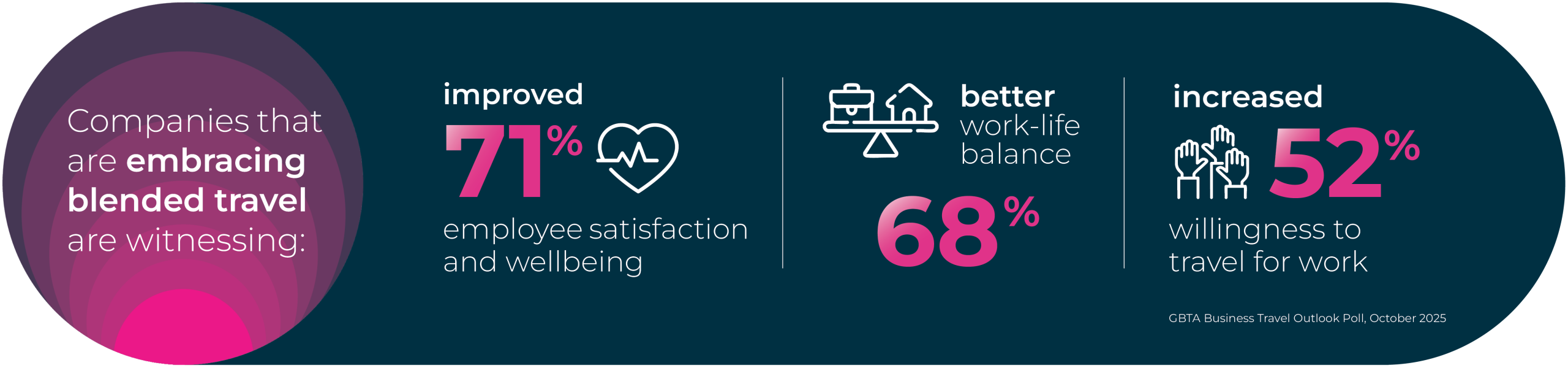
Companies that are embracing blended travel are witnessing:
- improved employee satisfaction and wellbeing – 71%
- better work-life balance – 68%
- increased willingness to travel for work – 52%
As we head into 2026, companies that seek to implement a formal blended travel policy will need to consider areas such as:
- duty of care and traveller safety
- expense tracking and reimbursement
- insurance coverage
Working with your travel management (TMC) will be important to smooth out these processes within your policy.
3. Accessibility and inclusion remain areas of growing focus
Awareness of accessibility within business travel continues to be a topic of discussion, with travel programmes taking steps to better support travellers with diverse needs.
According to GBTA’s latest poll, 58% of respondents in North America, 53% in Asia Pacific, and 52% in Latin America say their programmes accommodate employees with accessibility needs, compared with 47% in EMEA. While progress varies by region, the results highlight that accessibility is becoming a greater focus for travel managers and suppliers alike.

Across all respondents, 18% say their programme extensively accommodates accessibility needs, while around 33% do so to a moderate degree. This gradual shift includes improvements such as:
- Accessible hotel options and ground transport
- Neurodiversity-friendly travel environments
- Clearer communication around assistance requests
As more employees share their needs, forward-thinking organisations may seek to embed accessibility into every stage of the traveller journey, from booking to return, ensuring inclusivity becomes a lasting feature of business travel.
4. Travellers are investing in their own wellbeing
Business travellers are increasingly personalising their journeys even when their company doesn’t cover the cost.
43% of travel managers report that employees are personally paying for upgrades to enhance their travel experience. The most common purchases include:
- Flight cabin and seating upgrades – 78%
- Airport lounge access – 30%
- Additional hotel nights for bleisure stays – 29%
- Hotel room upgrades – 26%

Regionally, self-funded upgrades are more prevalent in North America and the Asia Pacific (51%), compared with 27% in EMEA and 25% in Latin America.
This behaviour highlights a growing desire among business travellers to invest in comfort, rest, and productivity viewing wellbeing as essential to performance, not a perk. For organisations, it’s a reminder to evaluate whether their travel programme truly supports traveller wellbeing or simply manages logistics.
5. Technology enhances, not replaces, the human touch
Artificial intelligence, particularly agentic AI, is starting to shape travel operations.
Suppliers and TMCs are leading adoption, using AI for:
- Customer service – 60%
- Personalised traveller recommendations- 55%
- Automated itinerary planning – 42%
The best travel programmes will continue to combine AI’s efficiency with the empathy of human service, creating travel experiences that are both seamless and personal for business travellers.